
Teaneck City Directory Collections
The surviving shelf is a mix of regional directories, telephone books, and local archival material. The New Jersey State Library catalog specifically identifies Richmond's Hackensack editions for 1926 and 1928 and a Polk's Hackensack edition for 1931 as including Teaneck. Catalog descriptions say the broader Hackensack run extends from 1915 to 1947 with gaps. That is useful coverage, not proof that every year or every person is available.
| Collection | Years noted | Where to start | Access note |
|---|---|---|---|
| Richmond's Hackensack directories | 1926 and 1928 | NJ State Library catalog | Each catalog record says Teaneck is included. |
| Polk's Hackensack directory | 1931 | NJ State Library catalog | Listed with Teaneck in its scope. |
| Northern New Jersey telephone book | 1930-31 | Bergen Historical Society inventory | Subscriber and address-oriented material. |
| Bergen-Passaic telephone directory | 1948 | Bergen Historical Society inventory | Check the geographic section before relying on a listing. |
| Bergen white-page and area editions | 1960s-1980s, plus 1988 | Bergen Historical Society inventory | Runs and local coverage vary by edition. |
For a later business lead, the same inventory lists 2007, 2016, and 2018-19 business or Yellowbook editions. Record the title, date, coverage statement, page, and the edition checked before treating any listing as evidence.
Teaneck Directory Years and Gaps
A gap is part of the evidence. The named 1926, 1928, and 1931 publications are cataloged holdings, while the broader 1915-1947 span is described with gaps. A missing year may reflect an unheld volume, a regional scope that skipped an area, or a person who was not listed. It should not be converted into a claim that a family was absent.
The Bergen Historical Society inventory gives useful comparison points: Northern New Jersey for 1930-31, Bergen-Passaic for 1948, Bergen County white pages for 1960-61, 1961-62, 1971, 1974, 1975, 1977, and 1981, then Hackensack-area and Bergen editions from the 1980s. A 1988 white-pages edition covers an area including Hackensack, Bogota, South Hackensack, Teaneck, and West Englewood. These are separate products, so their headings and intended geography matter.
For an image of a county historical starting point, see the Bergen County Clerk's Teaneck history page.
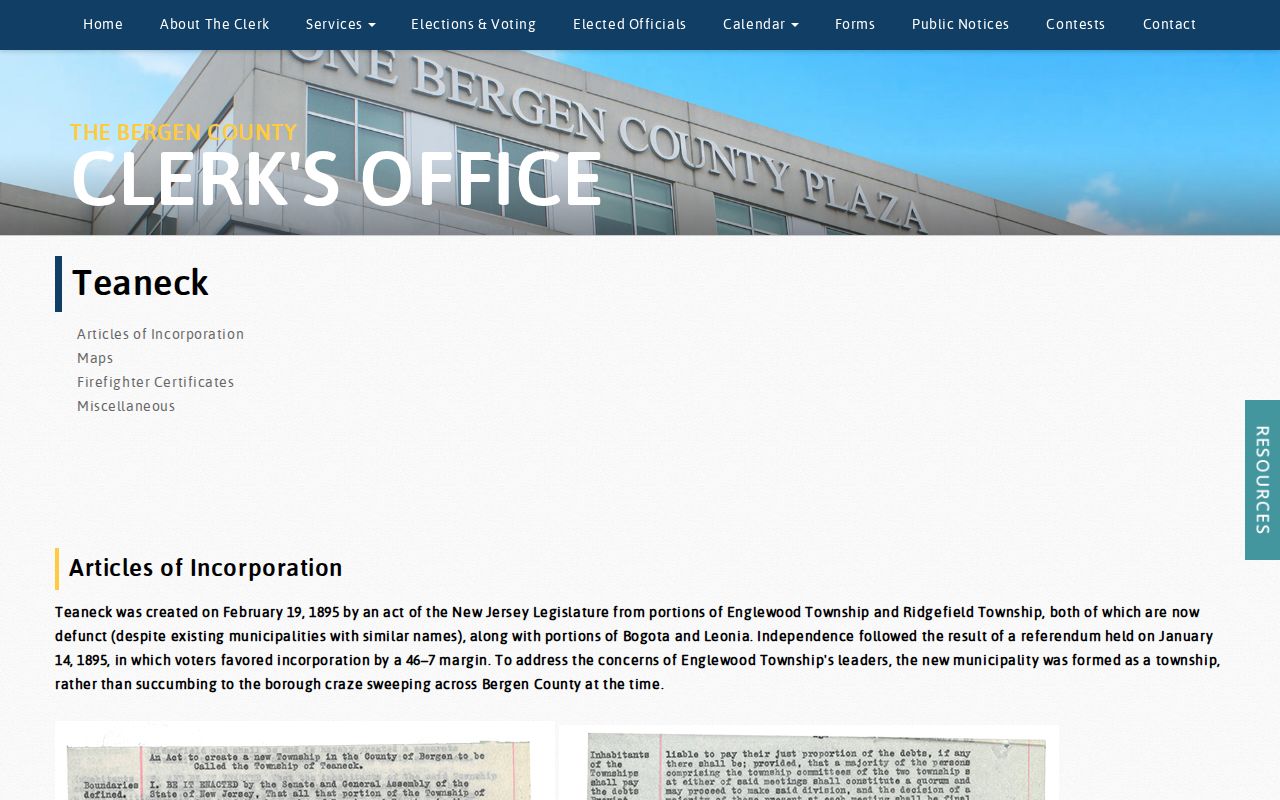
The page gives local context for the municipality's creation, which can help explain why an older catalog or record uses a predecessor place name.
Teaneck Library Directory Desk
The Teaneck Public Library is the practical local starting point at 840 Teaneck Road. Its resources page points researchers to in-library Ancestry Library Edition, remote HeritageQuest, BCCLS electronic sources, in-library Newspapers.com, and the Teaneck History digital archive. Ancestry Library Edition includes census, military, church, vital, court, land, probate, and passenger material. HeritageQuest is identified as offering city directories as well as other historical collections.
A library card is available without charge to Teaneck residents and property owners who provide photo identification and a Teaneck address. The library describes alternate proof options, and the card reaches the BCCLS network. That wider network is especially valuable when a Teaneck lead is printed under a broader Hackensack or Bergen heading.
The library's research-resources page shows the available research paths and their access conditions.
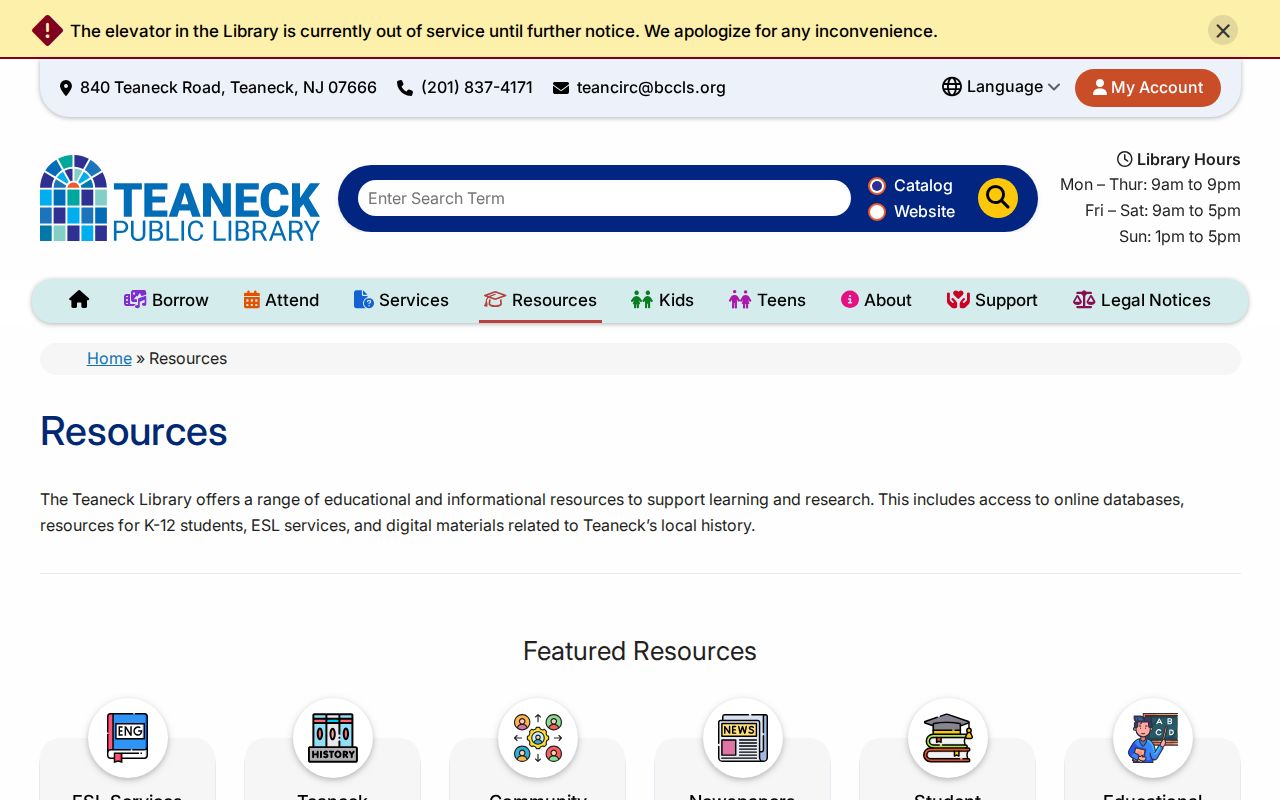
Use the access note beside each resource, since a database available inside the library may not have the same access from home.
Teaneck Archive Names and Places
The Teaneck History archive adds context that a printed listing cannot supply. Its categories include documents, oral histories, photographs, reports, memorabilia, business ownership, houses and landmarks, managers, mayors and council, New Deal and WPA material, the post office, railroad, religion, schools, and veterans. These are leads for placing a name in a documented public setting, not a substitute for a dated directory entry.
High school yearbooks are described as running from 1930 to the present. The archive also identifies Elizabeth S. Sample's 1930 historical sketch, annual manager reports from the 1930s onward, the 1948 civic review Your Town, house-tour clippings, postal material, and historic-burial-ground material. A name in one of those sources should be recorded with its creator, date, and item title.
The Teaneck History archive is the direct gateway to those categories.
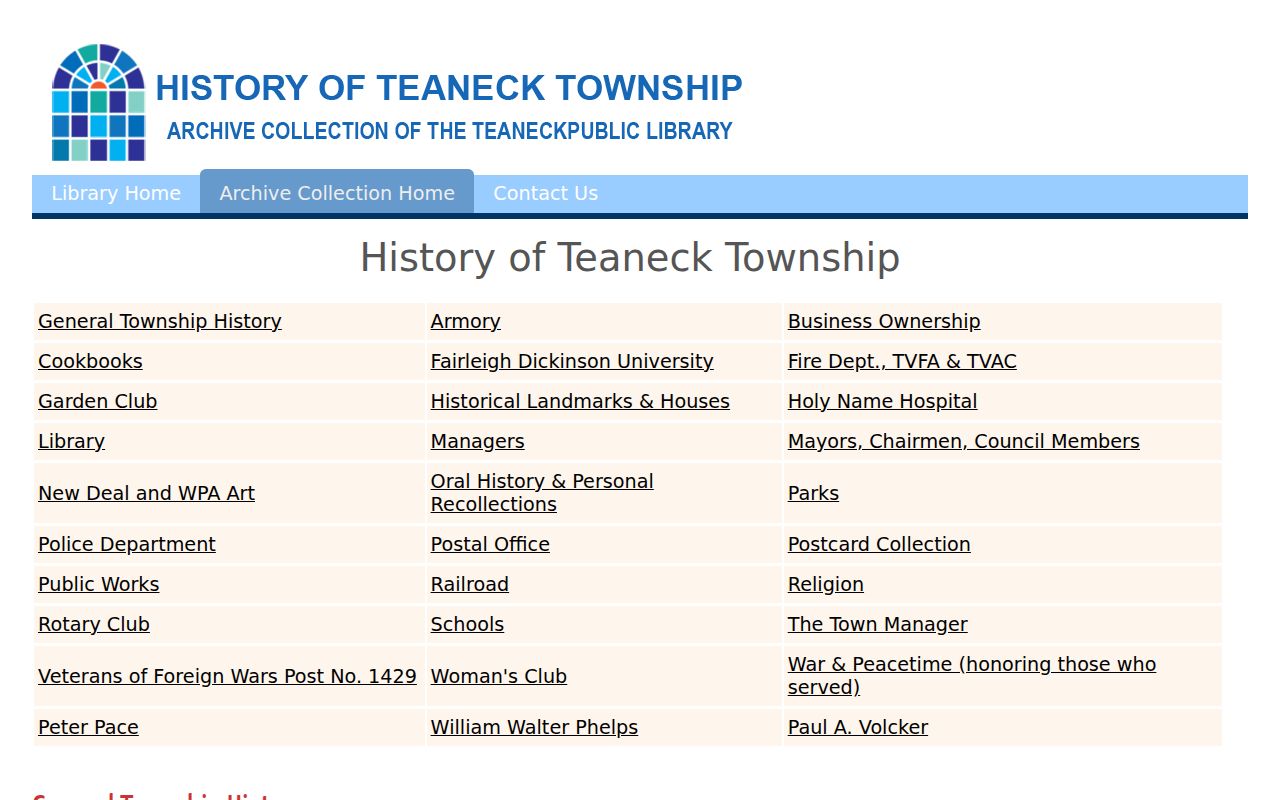
Archive categories can point to a school, civic office, business, or landmark that helps distinguish people with similar names.
Reading a Teaneck Directory Entry
The verified catalog descriptions support a careful inventory, not a made-up transcription. For the Richmond and Polk editions, note the printed name, street or address, any activity or business designation, household or firm heading, page, and the volume's stated coverage. Telephone books can add a subscriber name, address, exchange or number, and a residence or business heading. Keep what is printed separate from any later interpretation.
| Printed name | Copy it as shown, including initials, punctuation, and spelling. |
|---|---|
| Street or address | Record the original form before creating a separate normalized search form. |
| Activity or business label | Transcribe it only if the selected edition actually prints one. |
| Household or firm heading | Preserve the heading exactly; it may identify a subscriber or organization rather than every person there. |
| Edition and page | Keep the title, publication year, geographic scope, and page with the note. |
- Criss-cross section
- A street-ordered portion of a directory when a particular volume includes one. Confirm its presence in that edition before relying on it.
- Householder index
- A name arrangement that may emphasize the listed household contact rather than every person at an address.
- Abbreviation key
- The volume's own explanation of shortened terms. Photograph or transcribe it before expanding any abbreviation.
No verified scan-level Teaneck entry or complete physical run was located in the research. Review the original page or volume before quoting a mark, relationship, or abbreviation.
Bergen Sources for Teaneck Directories
The Bergen County Historical Society and the Genealogical Society of Bergen County offer a wider set of companion sources: more than 2,500 local-history volumes, over 200 family genealogies, church, cemetery, Bible, and diary material, maps, photographs, clippings, and indexed manuscripts. The holdings description also notes more than 650 manuscript envelopes with original deeds, letters, tax lists, receipts, mortgages, and road petitions.
Those materials can bridge an absent directory year or help sort two alike names by associating a person with a church, map, road petition, family paper, or public institution. They are not an invitation to fill a gap with a guess. Use the title and date of the supporting item, then return to the printed source for the actual directory wording.
The Bergen County Historical Society library describes the archival setting for this material.
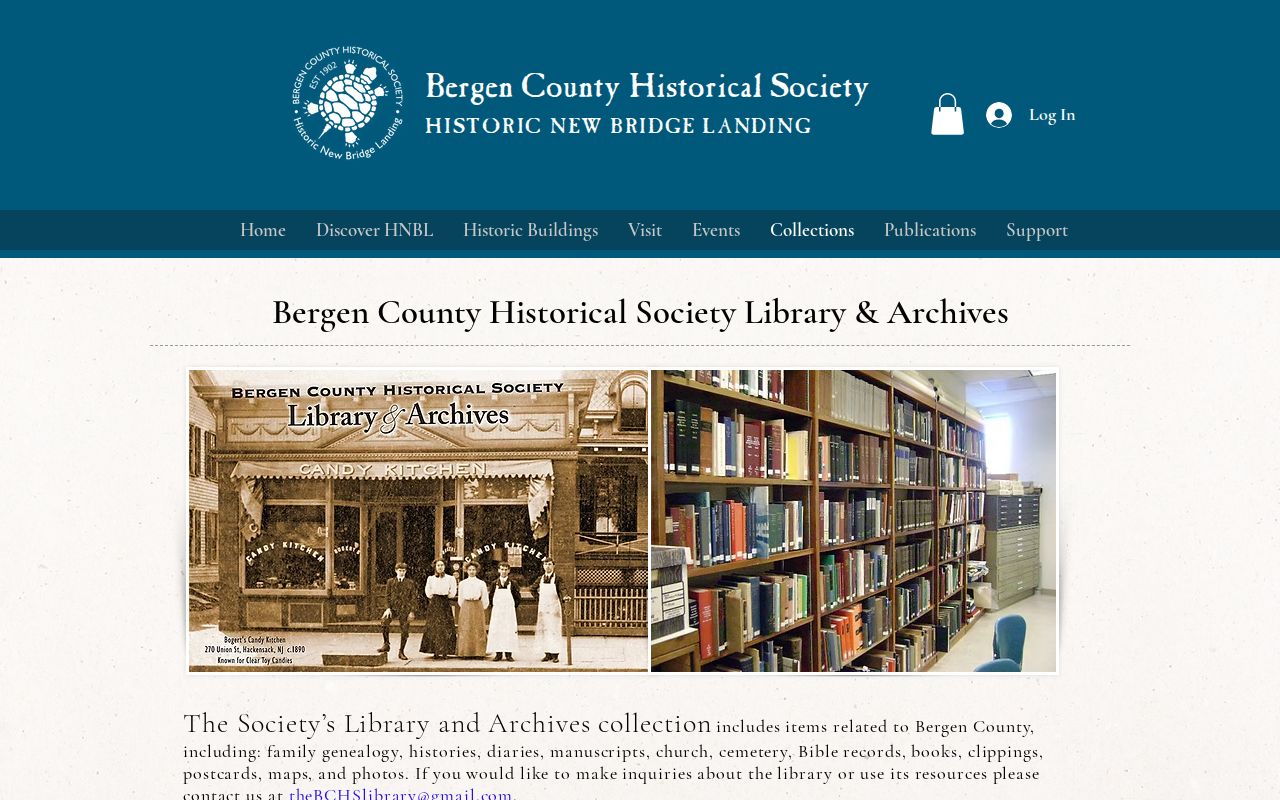
Maps, family material, and original manuscripts provide independent context when a printed volume leaves a question open.
Teaneck Directory Timeline
The available dates form a useful research timeline rather than a complete publication history. Start with the named catalog records, then place telephone editions beside them as separately scoped sources.
- 1915-1947: broader Hackensack directory coverage described with gaps.
- 1926 and 1928: Richmond's Hackensack editions identified as including Teaneck.
- 1930-31 and 1931: Northern New Jersey telephone material and Polk's Hackensack edition.
- 1948 through the 1980s: Bergen-Passaic, Bergen County, and Hackensack-area telephone editions at selected dates.
- 2007, 2016, and 2018-19: business or Yellowbook editions listed in the local inventory.
The library's Cedar Lane history is one example of an archival item that can add a date and place context to the name trail.
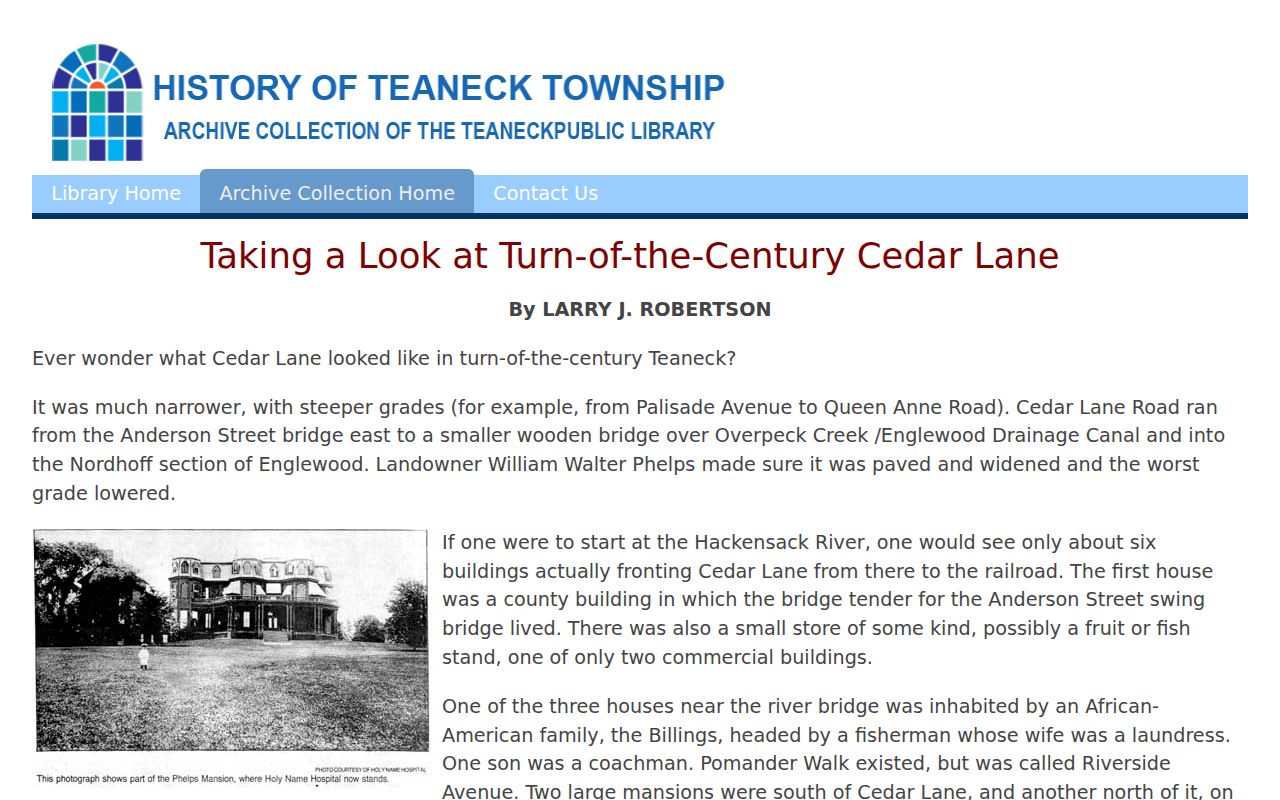
A local history page can explain why an address or street form in a dated listing differs from a present-day label.
Trace Teaneck City Directories
A family-history search is strongest when it follows a name across more than one edition and then asks whether the address, spelling, and surrounding historical evidence agree. The aim is to build a dated sequence, not to force continuity from a single listing.
- Start with the closest verified edition and copy the printed name, address, page, and coverage statement.
- Check an earlier and a later available volume, even if the editions are several years apart.
- Search the same address or former street form in a relevant telephone book or street-ordered section when one is available.
- Pair the dated listing with the closest suitable census schedule or library database result, keeping the source roles separate.
- Use an archive, newspaper, deed, cemetery, or family manuscript only as a second source that supports or questions the sequence.
A disappearance can mean a move, a change in listing practice, a missing edition, a changed spelling, or no listing at all. The surrounding years and original volume are the better test.
Teaneck Directory Address Changes
Old street labels can make a sound listing look wrong at first glance. Teaneck's historical sources identify John Street South as formerly Orchard Court, Overlook Avenue as Parkway, Palisade Avenue as Station Street, and Pomander Walk as Riverside Avenue on its west segment and Kipp Avenue on its east segment. Queen Anne Road was previously Westfield Avenue, and Teaneck Road north of Cedar Lane was once Washington Avenue.
Keep both forms in the research note: the exact printed address and a separate normalized current search form. The 1934 engineering report also says directional numbering used different reference points, with north numbering governed by the Ridgefield Park boundary and east-west numbering organized by Teaneck Road. A number that seems out of sequence may therefore deserve a map and archive check before it is rejected.
The Historic Preservation Commission street-name material provides the research basis for those comparisons.
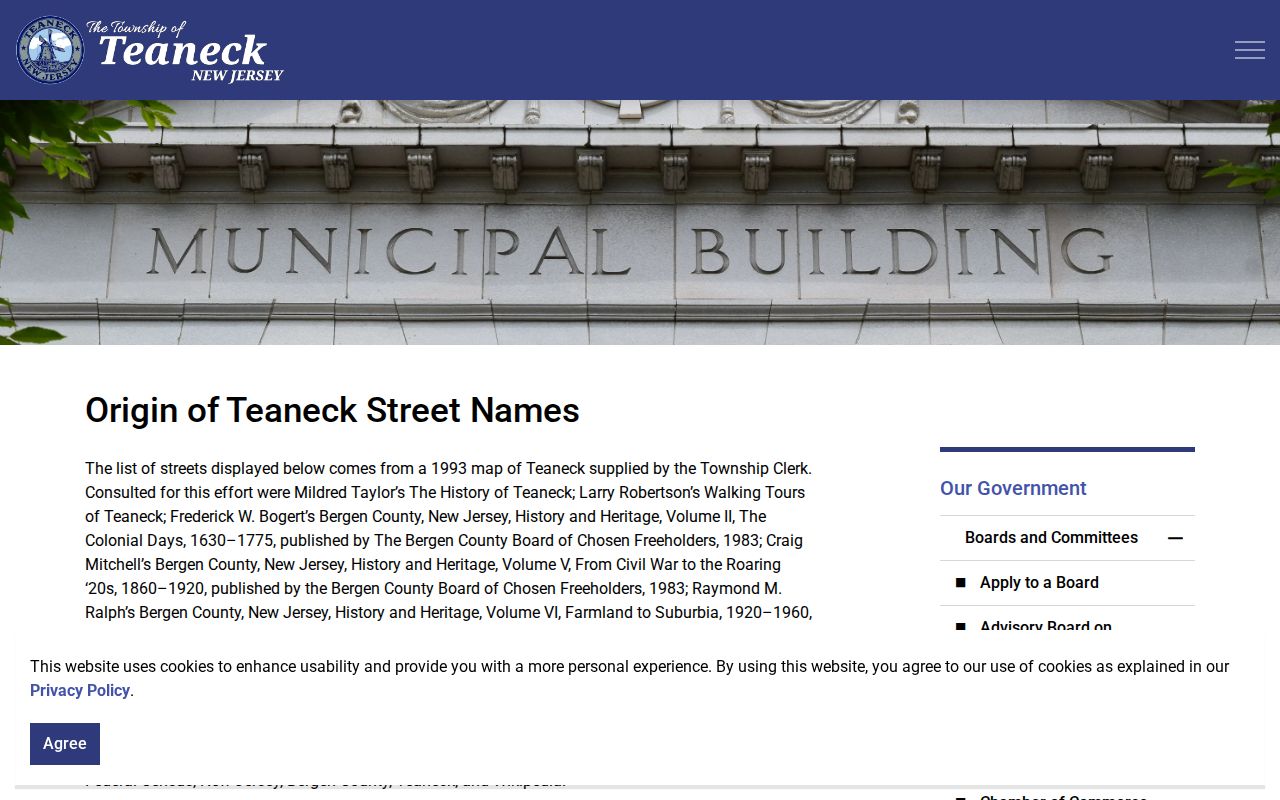
Searching both the printed and later street labels is a practical way to avoid losing a record to an address change.
Limits of Teaneck Directories
A listing may identify a subscriber, household contact, business, or person receiving mail at an address. It may omit children, boarders, unlisted numbers, people who moved between editions, and many other people connected with a place. A name in a volume is a useful dated lead, but it does not by itself establish ownership, a full household, or continuous presence.
For present-day address work, use the Teaneck streets page; for an address moving backward through deeds and dated household sources, use the Past Residents page. The historical shelf remains most useful when each record keeps its own date and limits.